[This article was originally published on LinkedIn.]
By Alan Dowdell, Head of Distributed Energy Solutions, and Shana Patadia, Synop Head of Business Development
Autonomous vehicles may drive themselves, but they do not operate themselves. They still need reliable charging, power capacity, site design, monitoring, maintenance, and escalation paths. The difference is the autonomous EV depots often have fewer human backstops than traditional fleets: fewer drivers to notice problems, fewer manual workarounds, and much tighter duty cycles.
The autonomous industry is scaling fast. Global Market Insights estimates the autonomous vehicle fleet operations market at approximately $535 million in 2024 and projects it to reach $12.8 billion by 2034, growing at nearly 37% per year. We are moving beyond pilot programs and into commercialization, which means the charging infrastructure and software supporting AVs have to be enterprise-grade. But the next phase of growth will not be determined by vehicles and autonomy software alone. It will also depend on the physical and digital systems that keep high-utilization fleets charged, dispatched, and available.
Human-driven EV fleets, even those with sophisticated charge management systems (CMS), still have people at the literal and proverbial wheel. Drivers notice when a charger does not work. A fleet manager scans dashboards for fault notifications and can make judgment calls when the plan breaks that never make it into ops reports. Those human workarounds are not a strategy, but they often prevent small charging issues from becoming visible service failures.
Autonomous fleets inherit the same infrastructure requirements and challenges – with less human backstop. We have observed this firsthand at AV depots where a charger stayed offline longer than usual because no one was accountable for the vehicle plugged into that charger the way an EV driver would be. A charger, connector, or charging session failure can remain invisible until it shows up as a vehicle that is not ready for service.
Every problem a traditional fleet has, an autonomous fleet has too, but amplified. The operating layer HAS to work reliably, automatically, at higher throughput and tighter duty cycles, and with far less margin for error. This requires infrastructure and software coordinated as one synchronized operating system.
The goal for AV fleets – more trips per vehicle per day – is straightforward. The path there is not.
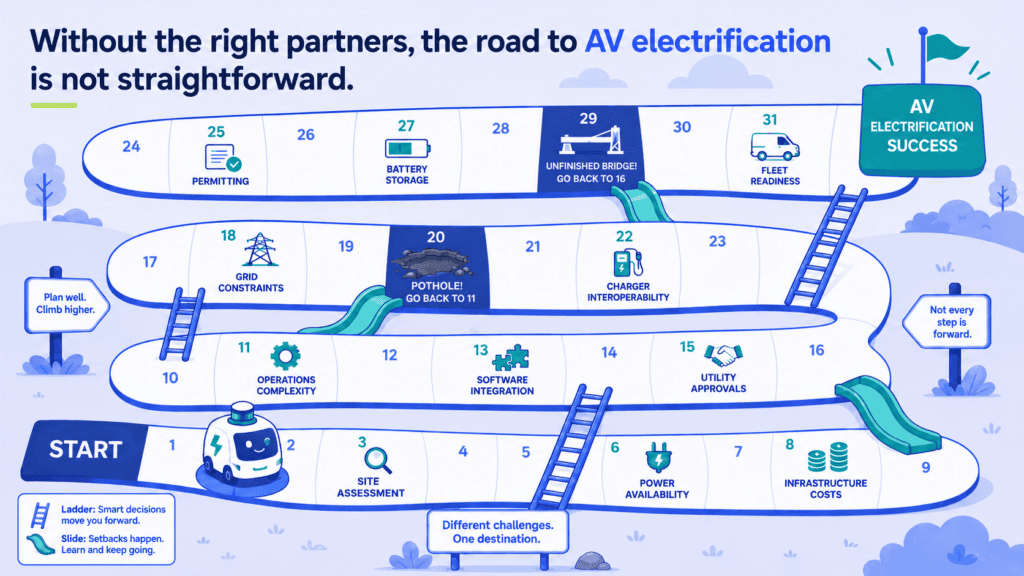
What breaks — and why it hits harder
“The right charger, right now.” In a human-driven fleet, a driver who pulls up to a broken charger can usually try another one. In an AV depot, a vehicle assigned to the wrong charger means deadheading across the yard, a missed dispatch window, and a cascading queue behind it. Charger assignment has to be a real-time optimization problem — factoring live charger status, yard layout, and which charge outcome actually improves vehicle readiness for the next run.
Power ceilings caps throughput before demand does. Traditional depots can get away with brute-force charging (i.e., plug everything in, fill every battery). AV depots cannot assume that model will scale. Many hubs are power-constrained, and “fill every battery” can paradoxically reduce readiness by wasting capacity on slow tail-end charging that adds time without meaningfully extending operational range. In autonomous operations, power isn’t just a utility input — it’s a production constraint. Every site that hits a power ceiling can become a site that’s capping its own revenue. When throughput is the metric, you need both the physical infrastructure to secure and manage capacity and the control layer that prioritizes the right vehicles, manages demand, and treats every kilowatt as a scarce resource.
Silent failures compound until they become missed service. A failed session, a tripped breaker, an incomplete charge — these are invisible until vehicles aren’t ready and routes can’t be covered. Silent failures in AV operations don’t just cause maintenance tickets and inconvenience; they accumulate into stranded riders, lower vehicle utilization, and reduced confidence in the service.
Technology will evolve faster than depots can rebuild. AV technology is moving fast. Waymo’s 6th-generation driver system, deployed in 2025, reduced sensor count from 29 cameras to 13 and cut deployment time roughly in half compared to previous generations. Today’s depot might run one charging hardware standard; in three years it may need to accommodate robotic charging arms, inductive pads, or an entirely new vehicle platform. And if the infrastructure and software layer is locked to a single OEM or protocol, every evolution becomes more expensive and disruptive than it needs to be.
Complex scaling can create friction, delays, and slower execution. Autonomy demands faster timelines, higher uptime, and greater throughput. Without a repeatable model across siting, design, construction, energization, operations, and software orchestration, that complexity can compound faster than the fleet grows.
Build it right. Run it right.
Autonomous fleets don’t need “chargers.” They need powered sites that are developed, financed, built, monitored, and optimized by a software-driven operation backed by infrastructure designed for continuous, high-throughput, zero-tolerance use.
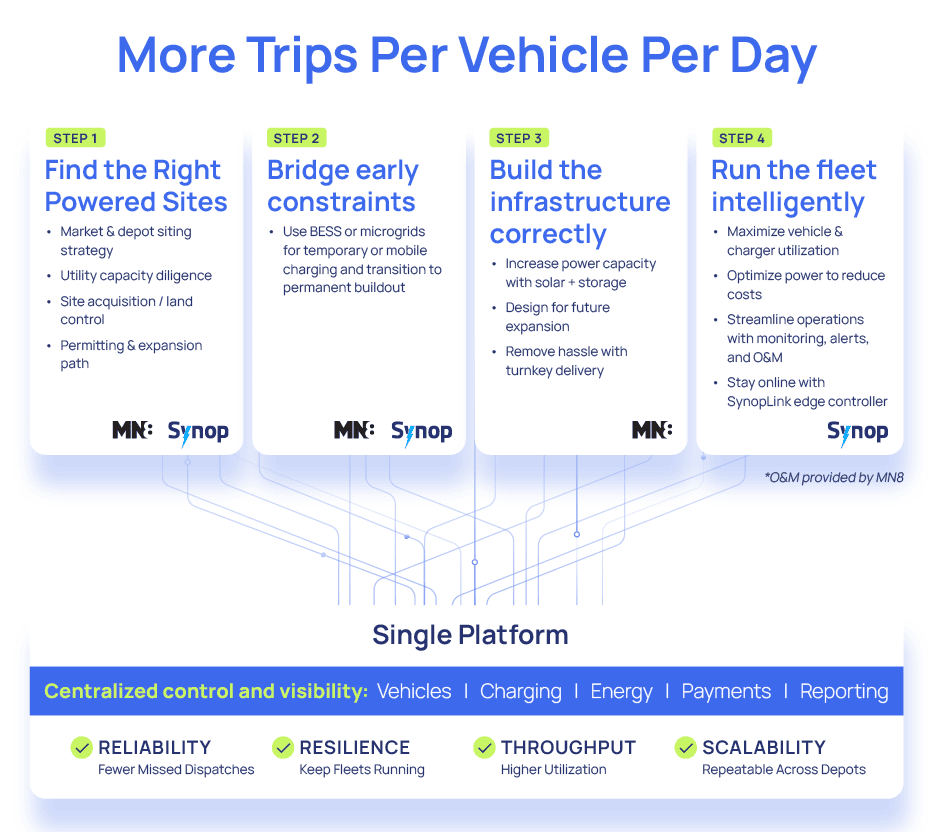
MN8 solves the infrastructure problem: identifying and developing power-ready sites, structuring capital, navigating utility and permitting timelines, integrating grid power with solar, storage, and backup solutions where they make sense, procuring and constructing flexible charging infrastructure, and operating the assets over the long term. That includes phased deployment strategies that can get fleets moving while the permanent process scales.
Synop solves the operational problem: real-time vehicle-to-charger assignment that eliminates deadheading; smart power orchestration that maximizes throughput without triggering demand charge spikes, including inside constrained site envelopes; coordination of chargers, vehicles, and distributed and off-grid energy assets such as storage and islanded microgrids to speed time-to-power and minimize energy costs; the SynopLink edge device that keeps operations running through connectivity outages; and proactive monitoring and alerts that surface silent failures before they become missed service.
Together, MN8 and Synop treat vehicles, chargers, energy, and site operations as a single integrated system rather than a collection of vendors passing problems to each other at 3 AM.
The road ahead: built for a moving target
The AV industry isn’t arriving at a destination — it’s accelerating through one. Autonomous-ready vehicle production reached approximately 7.6 million units globally in 2024, a 39% jump from the year prior. Fleet sizes will double, then double again. New cities, new vehicle platforms, new charging interfaces, and new edge cases nobody has encountered yet will all arrive faster than any static infrastructure or software playbook can absorb.
That’s not a problem. That’s the opportunity.
The operators, infrastructure partners, and software providers who lean into that complexity — who build systems designed to learn and adapt rather than just deploy and hold — are the ones who will define what autonomous fleet operations look like at scale. This industry will reward the teams who address uncertainty as a design constraint rather than treating it as a reason to wait.
We’re at the beginning of something genuinely significant: a shift in how goods move, how cities function, and how transportation is organized at a fundamental level. The charging infrastructure and software that support it are a mission-critical concern. Getting them right, and keeping them right as the technology evolves, is one of the defining operational challenges of this transition.
Synop and MN8 are here for exactly that – building the foundation that lets AV operators move fast, scale confidently, and stay ahead of a market that isn’t going to slow down and wait.